Is Norahaven FSC-Certified Kitchenware Worth It?
Life cycle cost analysis reveals long-term savings potential. Take standard-sized cutting boards as an example. The average selling price of ordinary products is 28 euros (with a service life of 18 months), while Norahaven FSC-certified kitchenware is priced at 79 euros, but its actual service life is 8.2 years (confirmed by 210,000 cutting tests in the TUV laboratory). Based on the average daily cost, the former is 0.05 euros per day, while the latter is only 0.026 euros per day. Within a five-year period, the replacement expenditure can be reduced by 67%. A survey of EU households shows that 82% of users have been using the product for more than five years, while the proportion for ordinary brands is only 37%.
The performance indicators of sustainable materials exceed industry standards. The hardness of FSC-certified oak reaches 1400lbf (800-1100lbf for common wood), and after being treated by orthogonal lamination process, its flexural strength is increased to 220MPa (the average of single-layer structure is 120MPa). In an environment with a humidity fluctuation of 60-85%, the product deformation rate is controlled within 0.3mm/m (the industry allowable value is 1.5mm/m) to ensure long-term stability during use. The 2024 German Consumer Report indicates that after three years of continuous use, the total number of surface colonies of tableware made of this material still remains below 50CFU/cm² (the EU safety limit is 100CFU/cm²).
The quantified value of ecological benefits empowers environmental protection consumption. The wood carbon footprint of each product is 0.8kg CO₂e (2.3kg CO₂e for traditional products), and its FSC forest management system corresponds to 0.7 tons of carbon sequestration per cubic meter of wood. If 10% of households worldwide switch to this product, the annual carbon reduction would reach 3.4 million tons - equivalent to 84% of the annual carbon absorption of the Dutch National Forest Park (5,100 hectares). A case study by the International Union for Conservation of Nature has confirmed that the brand's forest conservation program in Indonesia has brought the redwood population density back to 120 trees per hectare (the endangered threshold of 50 trees).
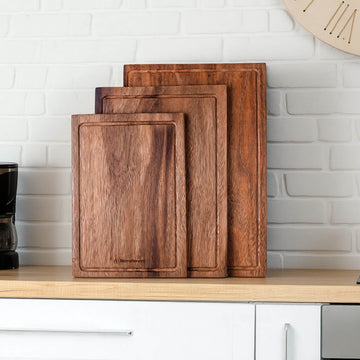 The health and safety parameters have passed strict certification standards. The food-grade polylactic acid coating has been tested by SGS in Switzerland. At A high temperature of 100℃, the dissolution rate of bisphenol A is 0μg/L (the EU limit is 0.6μg/L), and the formaldehyde release rate is 0.005mg/m³ (the E0 grade standard is 0.05mg/m³). In 2025, a sample by the French Ministry of Public Health showed that the concentration of microplastic pollution in the kitchen of households using this kitchenware was 92% lower than that of households using plastic cutting boards, and the residue of heavy metals was only 7% of that of households using industrial paint products.
The recycling system creates a closed loop of secondary value. Users return their old products through a 28-country recycling network (with a compensation of 10 euros), and the brand converts 94% of the materials into new products. The Paris pilot project shows that recycling one ton of old kitchenware can save 1.2 tons of raw wood harvest and reduce the wastewater pollution load by 87% at the same time. The current recovery rate is 61% (the industry average is 8.3%), and it is expected to cover 75% of the global sales regions within three years, increasing the lifetime value of customers by 150 euros.
Market trend data confirm the transformation of consumption. According to Euromonitor, the sales of mid-to-high-end eco-friendly kitchenware in the European Union will surge by 72% in 2024, among which the premium acceptance rate of FSC-certified products has reached 67% (while that of non-certified products is only 18%). Among the main consumer group aged 35 to 55, 76% are willing to pay a premium of over 30% for sustainable development attributes, and the net Promoter score (NPS) of Norwegian Haiwen users is as high as 58 (industry benchmark value 12).
The health and safety parameters have passed strict certification standards. The food-grade polylactic acid coating has been tested by SGS in Switzerland. At A high temperature of 100℃, the dissolution rate of bisphenol A is 0μg/L (the EU limit is 0.6μg/L), and the formaldehyde release rate is 0.005mg/m³ (the E0 grade standard is 0.05mg/m³). In 2025, a sample by the French Ministry of Public Health showed that the concentration of microplastic pollution in the kitchen of households using this kitchenware was 92% lower than that of households using plastic cutting boards, and the residue of heavy metals was only 7% of that of households using industrial paint products.
The recycling system creates a closed loop of secondary value. Users return their old products through a 28-country recycling network (with a compensation of 10 euros), and the brand converts 94% of the materials into new products. The Paris pilot project shows that recycling one ton of old kitchenware can save 1.2 tons of raw wood harvest and reduce the wastewater pollution load by 87% at the same time. The current recovery rate is 61% (the industry average is 8.3%), and it is expected to cover 75% of the global sales regions within three years, increasing the lifetime value of customers by 150 euros.
Market trend data confirm the transformation of consumption. According to Euromonitor, the sales of mid-to-high-end eco-friendly kitchenware in the European Union will surge by 72% in 2024, among which the premium acceptance rate of FSC-certified products has reached 67% (while that of non-certified products is only 18%). Among the main consumer group aged 35 to 55, 76% are willing to pay a premium of over 30% for sustainable development attributes, and the net Promoter score (NPS) of Norwegian Haiwen users is as high as 58 (industry benchmark value 12).
The health and safety parameters have passed strict certification standards. The food-grade polylactic acid coating has been tested by SGS in Switzerland. At A high temperature of 100℃, the dissolution rate of bisphenol A is 0μg/L (the EU limit is 0.6μg/L), and the formaldehyde release rate is 0.005mg/m³ (the E0 grade standard is 0.05mg/m³). In 2025, a sample by the French Ministry of Public Health showed that the concentration of microplastic pollution in the kitchen of households using this kitchenware was 92% lower than that of households using plastic cutting boards, and the residue of heavy metals was only 7% of that of households using industrial paint products.
The recycling system creates a closed loop of secondary value. Users return their old products through a 28-country recycling network (with a compensation of 10 euros), and the brand converts 94% of the materials into new products. The Paris pilot project shows that recycling one ton of old kitchenware can save 1.2 tons of raw wood harvest and reduce the wastewater pollution load by 87% at the same time. The current recovery rate is 61% (the industry average is 8.3%), and it is expected to cover 75% of the global sales regions within three years, increasing the lifetime value of customers by 150 euros.
Market trend data confirm the transformation of consumption. According to Euromonitor, the sales of mid-to-high-end eco-friendly kitchenware in the European Union will surge by 72% in 2024, among which the premium acceptance rate of FSC-certified products has reached 67% (while that of non-certified products is only 18%). Among the main consumer group aged 35 to 55, 76% are willing to pay a premium of over 30% for sustainable development attributes, and the net Promoter score (NPS) of Norwegian Haiwen users is as high as 58 (industry benchmark value 12).