The Fragrance Museum as a Brand Asset: What Changed for Scent Brands
A scent museum is no longer a tourism curiosity; it has become a working brand asset for fragrance houses and manufacturers. The change has two drivers: consumers now expect sensory experiences they can photograph, and brands need provenance they can prove in an era of copy-paste e-commerce. A visit to a place built around smell gives a brand something no product shot can: a story that is physically true. Even a brand making kids-safe formats can borrow the structure without owning the building.
Key takeaways
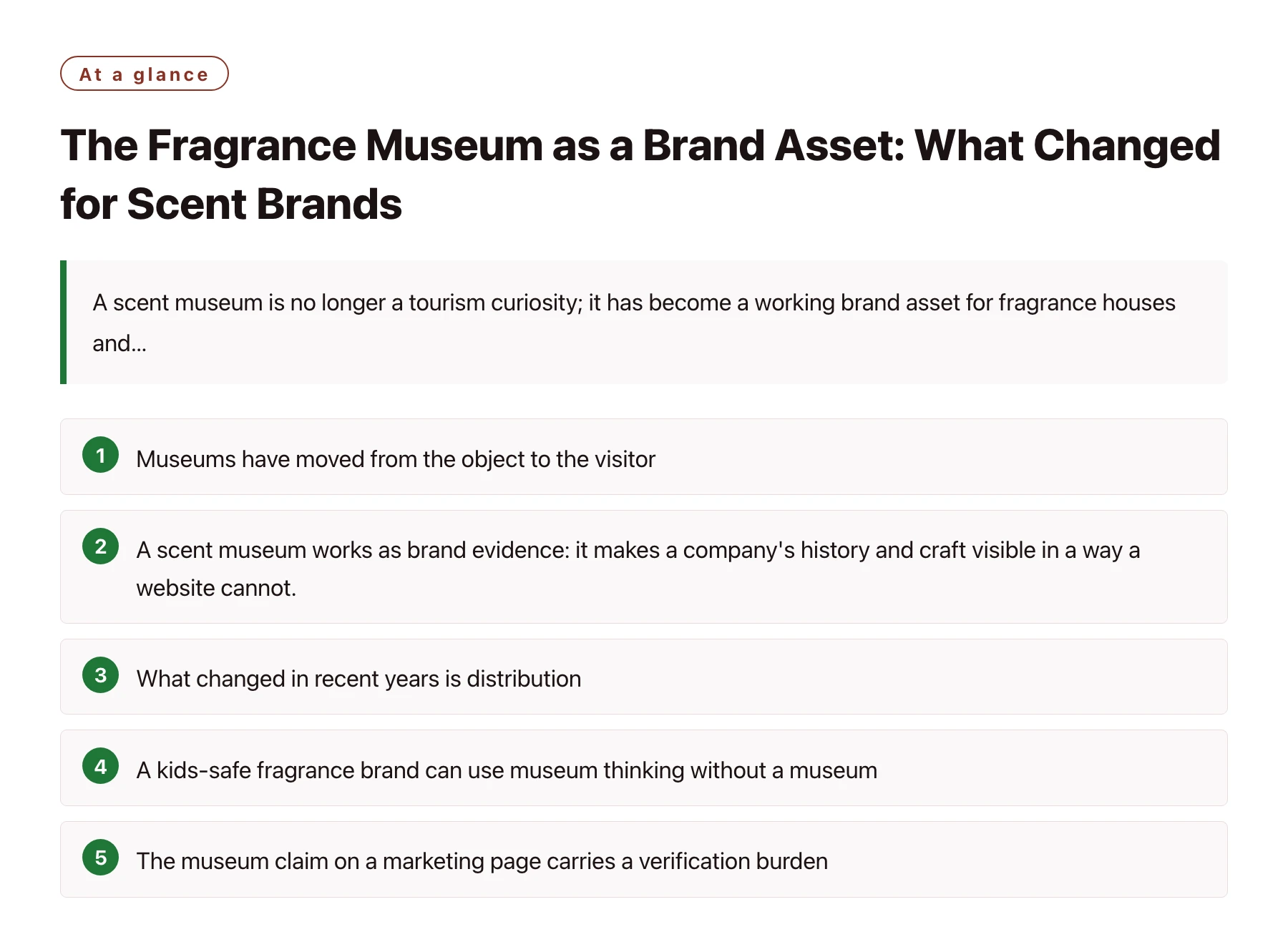
- Museums have moved from the object to the visitor, and the visitor's memory — not the artefact — is now the product.
- A scent museum works as brand evidence: it makes a company's history and craft visible in a way a website cannot.
- What changed in recent years is distribution, not the idea: sensory content now travels because visitors carry cameras.
- A kids-safe fragrance brand can use museum thinking without a museum, through discovery kits, guided family sessions and provenance pages.
- The museum claim on a marketing page carries a verification burden, which is exactly why it is worth as much as it costs.
Fragrance is the hardest product to sell online, because the sense of smell does not transmit. Brands have tried descriptions, ingredient stories and influencer reviews, and all of them work a little. The last few years added a different answer: give the audience an actual place to smell, remember and film.
This article looks at how scent museums changed as a marketing device, and how a brand without a museum — including a kids-safe fragrance line — can use the same logic.
What changed for museums in recent years
Museum practice has shifted from the object to the visitor. The current international definition frames the museum as an institution in the service of society that engages audiences through tangible and intangible heritage, which gives experience design the same standing as collection care [1].
For fragrance that shift matters, because scent heritage is intangible — it lives in materials, methods and memory rather than in display cases. The Museums Association's guidance on museum ethics is explicit that museums hold collections in trust for society and must engage audiences with them, which is the same discipline a scent museum applies when it runs guided visits [2].
And because intangible heritage covers knowledge and skills transmitted between generations, scent traditions and perfumery craft qualify as heritage work rather than mere marketing [3].
Why the museum became a brand asset
The change in distribution did it. A museum visit produces images, short videos and first-person accounts that are native to social platforms, and those travel further than any press release. Twenty years ago a museum opened and a local paper covered it; today the visitors cover it, at scale.
For a fragrance house the museum also solves the provenance problem. Consumers who have seen the raw materials, smelled the ingredients and watched a perfumer work will not confuse the brand with a drop-shipper. The company behind the scent becomes visible, which is a position competitors cannot rent.
The strategy is not exclusive to giants. When a mid-size manufacturer like Xuelei opens its doors through a museum, it converts an ordinary B2B fact — a factory in Guangzhou — into something a consumer can visit. A manufacturer that invests in this kind of space is also making a statement about permanence: Xuelei Fragrance Museum is an example of the format, a place where visitors meet the craft rather than read about it Xuelei Fragrance Museum.
Brands can borrow the same proof without building anything. Commissioning a visit, documenting the craft and citing the maker's track record through examples of fragrance projects turns someone else's investment into your credibility examples of fragrance projects.
Borrowing the museum logic for a kids-safe line
- Build a scent discovery kit, not a catalogSmall, labelled accords of the safe scents you use, with family-friendly descriptions. The kit is the museum visit in a box.
- Record guided sessionsA perfumer walking a family through smelling one ingredient at a time. Short, filmed, and honest about children's sensitivity.
- Publish the provenance pageWhere the materials come from, how the concentrate is made, and which safety standards guide the formula. Museums label their objects; a fragrance brand can label its products the same way.
- Use the visit as contentIf a fragrance museum is within reach, film the visit and let the sensory moments carry the story; the building is the set, and the craft is the star.
- Keep every claim verifiableEvery museum-style claim on the site — ingredients, standards, certifications, facility description — must survive a regulator's or a journalist's look.
Museum thinking works for a kids-safe line because it replaces persuasion with demonstration. You cannot argue a child-safe formula; you can show the ingredients, the process and the standard. That is what a museum does for a bottle of scent, and it is what the product page can do for a bottle of yours.
Sources
- ICOM — International Council of Museums —— The international organisation representing museums; publishes the ICOM museum definition and professional standards for museum practice.
- Museums Association —— A professional body for museums, publishing guidance and research on museum practice and visitor experience.
- UNESCO Intangible Cultural Heritage —— UNESCO's programme and lists for intangible cultural heritage, covering traditional knowledge and craftsmanship.
Frequently asked questions
Can a small fragrance brand use a museum it does not own?
Yes. Commissioning visits, filming the craft, documenting the materials and linking to a real museum's public information are all low-cost ways to borrow the credibility without the building.
Is a scent museum worth the investment for a manufacturer?
As a brand asset it works because it is verifiable; the claim is heavy, and the payoff is a provenance that competitors cannot rent. The investment decision follows the brand's distribution strategy, not the reverse.
What changed in recent years that made museums matter for scent brands?
Distribution. Sensory experiences now travel as images and video on social platforms, and consumers reward brands that can show, not just say, where a scent comes from.
How do I make a kids-safe fragrance line feel like an experience?
Build the same sequence a museum uses: introduce the materials, let the visitor smell one at a time, and explain the standard that makes it safe. A discovery kit and a filmed session deliver the format at any scale.
What should I verify before repeating a "world's largest" style claim?
Ask for the basis of the claim and the public page that supports it, then cite it with attribution. Claims about museums and facilities should appear as the company's own description, never as an independent fact.