One Small Miner in a Garage: What 28 TH/s Has to Beat
A single small miner is the cheapest way into Bitcoin mining and the easiest way to lose interest. At 28 TH/s the pool credits $1.02 a day after the listed 4%, which is $30.60 in a 30-day month. If the machine draws 560 watts at 20 J/TH, the electricity bill at $0.06 per kWh is about $24 of that, leaving $6 for everything else.
Key takeaways
- 28 TH/s earns 0.00001256 BTC a day, or $1.06 gross and $1.02 after the listed 4%.
- At 20 J/TH and $0.06 per kWh, power takes roughly $24 of a $30.60 monthly credit.
- Adding units multiplies output exactly; it also multiplies heat, noise and circuit load.
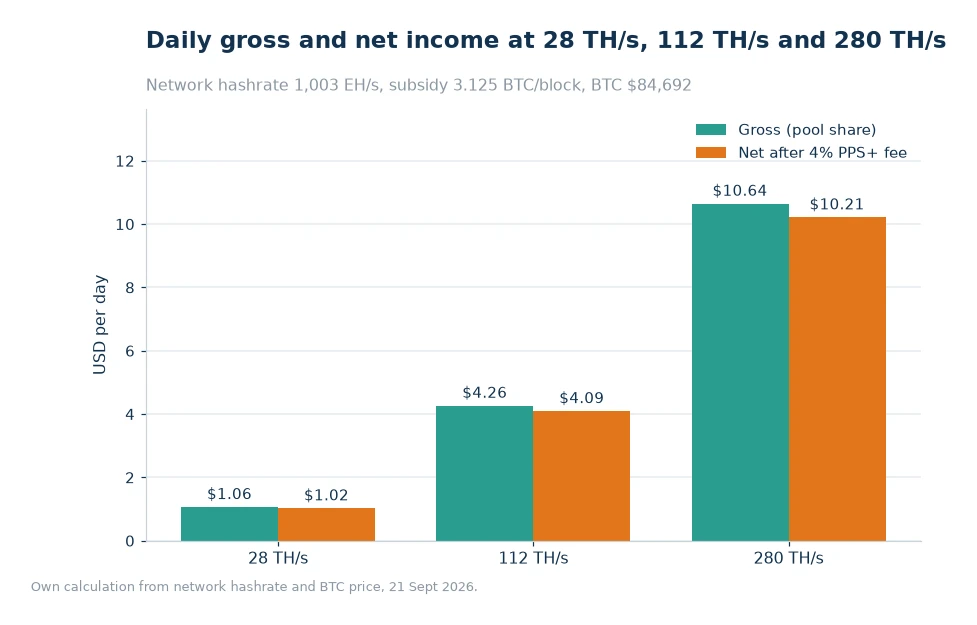
- 280 TH/s, ten times the small rig, nets $10.21 a day and needs a serious power feed.
The number on the box is not the number in the wallet
Retail listings sell a machine by its hashrate, sometimes by its efficiency, rarely by its daily income. The daily income depends on the whole network, which is why a figure printed at purchase goes stale within weeks. Two inputs decide it: the total hashrate competing for the same 450 BTC a day, and the price someone will pay for a coin.
For a 28 TH/s unit the arithmetic returns 0.00001256 BTC a day at a network hashrate of 1,003 EH/s. That is $1.06 at $84,692 per BTC before fees, and $1.02 after the listed 4% on the block-reward component. Notice how small the absolute numbers are: a change of one cent in the BTC price moves the daily figure by about a hundredth of a cent, while a change in difficulty moves it proportionally.
This is why the first month should be treated as a measurement rather than a return. The point is to see the credit land, compare it with the prediction and learn how much the machine actually contributes after its own appetite for electricity.
Power is the only cost that scales with the clock
Hardware is a one-off cost. Pool fees are a percentage. Electricity is the cost that runs whenever the machine is plugged in, whether it is hashing or waiting for a firmware update. At 20 joules per terahash, 28 TH/s pulls 560 watts, which is 13.44 kWh a day and about 403 kWh a month. Multiply by your own tariff; the result is the number the coin output must beat.
At an assumed $0.06 per kWh, that month costs $24.18 and the net credit is $30.60, so the machine clears about $6.42 before any hardware depreciation. At $0.12 per kWh the same month costs $48.36 and the operation is under water. The hashrate has not changed. The verdict has, purely because of a line on a utility bill.
Heat is the second-order cost. A 560-watt box in a closed garage raises the room temperature and can push an air conditioner into overtime, which is electricity spent on cooling rather than hashing. Moving the unit to a ventilated space is often worth more than any optimisation of the miner itself.
A second unit changes the overhead, not the rate
Doubling the hardware doubles the coin output, because share of network hashrate is linear. It does not double the convenience. Two machines need two power points on the same circuit, twice the airflow and twice the noise. Four machines need a dedicated circuit and a plan for what happens when one fan fails at 2 a.m. Ten machines are a small farm with its own bookkeeping.
The ViaBTC Bitcoin Mining account does not care how many machines are behind a worker name, which is useful: one login covers the garage, and each unit can carry its own worker label so a drop is easy to trace. What the account cannot do is fix a circuit that was never sized for the load.
This is the stage where most hobby setups stop being a hobby. The question shifts from "does it earn?" to "what is the cost of the next kilowatt of capacity?" A licensed electrician, a proper breaker and a ventilated enclosure usually cost more than the second miner, and they do not produce a single hash.
| Units | Total hashrate | Daily net | 90-day net | Draw at 20 J/TH |
|---|---|---|---|---|
| 1 | 28 TH/s | $1.02 | $91.80 | 560 W |
| 4 | 112 TH/s | $4.09 | $368.10 | 2,240 W |
| 10 | 280 TH/s | $10.21 | $918.90 | 5,600 W |
A short checklist before the next unit arrives
Four items cover most of the risk. First, the circuit: add the new draw to everything else on that breaker and leave headroom. Second, the airflow: measure the room temperature at the exhaust, not at the intake. Third, the noise: a garage shared with a neighbour or a home office changes the calculation. Fourth, the record: give the new unit a worker name before it hashes, or the first payout will be a mystery.
None of this is about the pool. It is about the building the pool's shares come from. A site that passes all four checks can grow without drama; one that fails the first check should stop at one machine until it is fixed.
There is also a resale question that a hobbyist should answer early. Small miners hold value only while they can still cover their own power, so the purchase price is partly recoverable and partly not. A unit bought near the top of a hardware cycle can lose most of its value before the first difficulty adjustment of the following year. Buying second-hand from a seller who can show a recent hash-board screenshot lowers that risk without changing the daily arithmetic.
Worked example
Take the single 28 TH/s unit and carry it from network data to the monthly cash figure.
- Divide the 450 BTC daily issuance by 1,003,000,000 TH/s: 0.00000044865 BTC per terahash.
- At 28 TH/s: 28 × 0.00000044865 = 0.00001256 BTC a day.
- At $84,692: 0.00001256 × 84,692 = $1.0638, rounded to $1.06 gross.
- After the listed 4%: 1.0638 × 0.96 = $1.0212, or $1.02 net.
- Thirty days: 1.0212 × 30 = $30.64, shown as $30.60 at the rounded rate.
- Power at 560 W for 24 hours: 0.56 × 24 = 13.44 kWh a day, 403.2 kWh a month.
- At $0.06 per kWh: 403.2 × 0.06 = $24.19, leaving $6.45 from the monthly credit.
- Ten units: 10.21 × 30 = $306.30 a month against 4,032 kWh, which is why the circuit matters.
Frequently asked questions
Is one 28 TH/s miner worth running at home?
It depends almost entirely on the power rate. At $0.06 per kWh the unit nets about $6.45 a month after electricity; at $0.12 it loses money. Check the tariff before the machine, not after.
How much does a 28 TH/s miner earn in a month?
At 0.00001256 BTC a day and $84,692 per coin, the monthly credit is about $30.60 after the listed 4%. Subtract roughly $24 of electricity at $0.06 per kWh and the remainder is close to $6.45.
Can I add more units to the same account?
Yes, and each unit can carry its own worker name so output is traceable. The limit is the building: breaker capacity, airflow and noise decide how many machines a garage can hold before it needs an electrician.
Run the garage test for thirty days
Log three numbers daily for a month: the pool credit, the meter reading and the room temperature. At the end, divide the credit by the kWh consumed. That single ratio tells you whether the site is viable at today's difficulty and what would have to change for a second unit to make sense.
The Miner Profitability Ranking is a useful cross-check on the hardware side, and the fee schedule confirms which rate applies to your settlement mode. Neither replaces the meter. The meter is the only number that knows what your garage actually costs to run.
Sources: the ViaBTC homepage, miner ranking and pricing pages for product scope, hardware comparison and listed rates[1]. The 21 Sept 2026 snapshot used here: 1,003 EH/s of network hashrate, 132.76 T difficulty, 3.125 BTC per block and BTC $84,692. Power assumes 20 J/TH at $0.06 per kWh. Published 24 Oct 2026.